
 España

Cast Steel Globe Valve
| Size | 2"~24" |
| Rating | 150LB~2500LB |
| Body Materials | Carbon Steel, Stainless Steel, Alloy Steel, Duplex S.S. XDSS, etc. |
| Design Standards | API 623/BS 1873 |
| Face to Face Standards | ASME B16.10, DIN3202, EN1092-1 |
| Flange Dimension Standards | ASME B 16.5, ASME B16.47, DIN2543, DIN2544 |
| Pressure Test Standards | API 598, DIN3230 |
| Quality/Product Certifications | ISO9001, ISO14001, ISO18001 |
| Fugitive Emissions | ISO 15848-1, API 622 |
| NACE | NACE MR 0103 NACE MR 0175 |
| Shutoff Class | API 598 (Zero Leakage) |
| End Connection | RF, RTJ, BW |
| Operation | Handwheel, Gear, Motor |
| NO. | PAPT NAME | MATERIAL-ASTM | 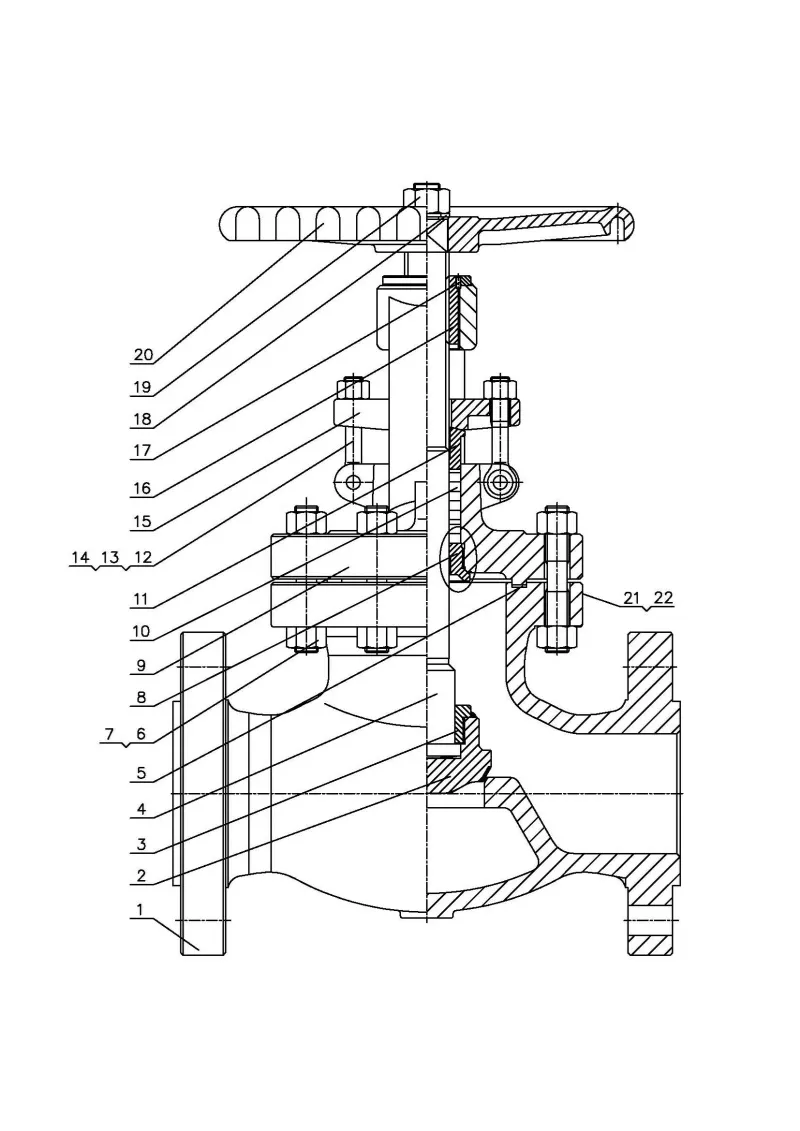 |
| 1 | BODY | ASTM A216 WCB 13CR | |
| 2 | DISC | ASTM A105 13CR | |
| 3 | DISC COVER | ASTM A105 | |
| 4 | STEM | ASTM A182 F6A | |
| 5 | GASKET | SS304 GRAPHITE | |
| 6 | BOLT | ASTM A193 B7 | |
| 7 | NUT | ASTM A194 2H | |
| 8 | BACKSEAT BUSHING | ASTM A182 F6A | |
| 9 | BONNET | ASTM A216 WCB | |
| 10 | PACKING | FLEXIBLE GRAPHITE | |
| 11 | PACKING GLAND | ASTM A182 F6A | |
| 12 | EYEBOLTS | ASTM A193 B7 | |
| 13 | NUTS | ASTM A194 2H | |
| 14 | PIN | ASTM A276 410 | |
| 15 | GLAND FLANGE | ASTM A216 WCB | |
| 16 | STEM NUT | COPPER ALLOY | |
| 17 | GRUP SCREW | C.S. | |
| 18 | WASHER | SS304 | |
| 19 | LOCK NUT | C.S. | |
| 20 | HAND WHEEL | KT33-8 | |
| 21 | NAME PLATE | SS304 | |
| 22 | RIVET | COPPER |
● Before installation, Valves not required for immediate use should be stored under clean conditions to reduce the risk of foreign matter entering the valve during unpacking. If the valves are unpacked for checking purposes, they should be immediately re-packed until required for use. Protection caps fitted to inlet and outlet connections must be removed together with any internal anti-corrosion sachets, but not until immediately prior to installation.
● Valves are suitable for flow in one direction only (as indicated on the body) and must be installed accordingly. They should be installed with the stem in either the upright or horizontal position. Other positions may be detrimental to the proper seating of the disk.
● The valves should be installed in positions where minimum stress is imposed on them from expansion and contraction of the pipe, and pipework should be adequately supported close to the valve to minimize mechanical pipe strain.
● All valves will have been pressure tested at ambient temperature before delivery so it is recommended that gland packing nuts should be tightened after a short time on higher temperature service.
|
Symptom |
Possible cause |
SOLUTION |
|
Leakage through the stem packing |
1. Gland nuts are loose. 2. Gland is binding against the stem or packing chamber wall. 3. Inadequate amount of packing rings. 4. Packing is hard and dry. 5. Packing was not properly cut and staggered. 6. Stem is damaged. |
1. Tighten gland bolts. 2. Check to ensure gland is centered and evenly tightened. 3. Install additional packing rings 4. Replace with new packing. 5. Replace with new packing. 6. Repair or replace as required. |
|
Problems in operating valve |
1. Stem binding during travel. 2. Stem packing is exerting excessive force on the stem 3. Stem is damaged. 4. Internal components may be damaged. |
1. Remove dirt and lubricate stem with grease. 2. Check torque on gland nuts. 3. Examine stem through full open and close action. Repair or replace as required. 4. Disassemble the valve. Inspect and repair as needed. |
|
Bonnet Leakage |
1. Bonnet nuts are loose. 2. Gasket is damaged. 3. Flange faces are damaged. |
1. Tighten to values as listed. 2. Disassemble and install a new gasket. 3. Repair and install a new gasket. |
|
Seat Leakage |
1. Valve not properly seated. 2. Internal components are damaged or worn. |
1. Check to see if valve is tightly closed. 2. Inspect internal components and repair as required. |


