
 España

Forged Steel Piston Check Valve
| Size | 3/8"~2-1/2" |
| Rating | 150LB~2500LB |
| Body Materials | Carbon Steel, Stainless Steel, Alloy Steel, Duplex S.S. XDSS, etc. |
| Design Standards | API 602/ASME B16.34 |
| Face to Face Standards | ASME B16.10 |
| Flange Dimension Standards | ASME B 16.5 |
| Pressure Test Standards | API598 |
| Quality/Product Certifications | ISO9001, ISO14001, ISO18001 |
| Fugitive Emissions | ISO 15848-1, API 622 |
| NACE | NACE MR 0103 NACE MR 0175 |
| Shutoff Class | API 598 (Zero Leakage), API 6D |
| End Connection | RF, RTJ, NPT, SW |
| Swing Check Valve | |||
| NO. | PAPT NAME | MATERIAL-ASTM | 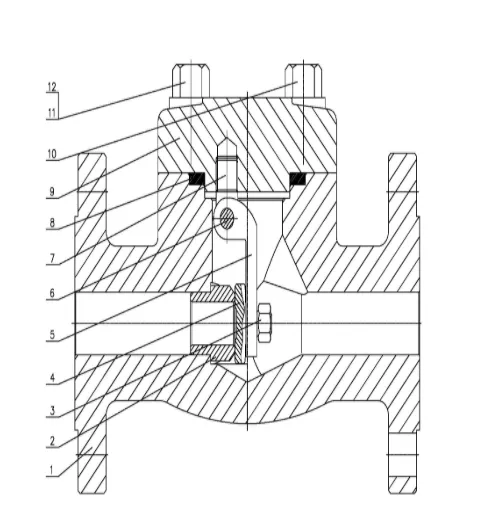 |
| 1 | BODY | ASTM A105 | |
| 2 | SEAT | ASTM A182 F6A | |
| 3 | NUT | ASTM A192 2H | |
| 4 | DISC | ASTM A182 F6A | |
| 5 | HINGE | ASTM A105 | |
| 6 | PIN | ASTM A276 410 | |
| 7 | FORK FRAME | SS304 | |
| 8 | GASKET | SS304 GRAPHITE | |
| 9 | BONNET | ASTM A105 | |
| 10 | HEX BOLT | ASTM A193 B7 | |
| 11 | NAMEPLATE | SS304 | |
| 12 | RIVET | COPPER | |
| Lift Check Valve | |||
| NO. | PAPT NAME | MATERIAL-ASTM | 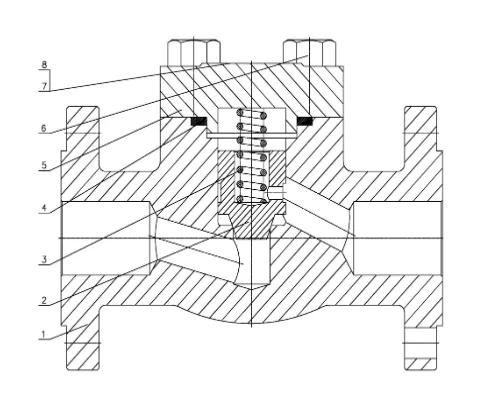 |
| 1 | BODY | ASTM A105 13CR | |
| 2 | DISC | ASTM A182 F6A | |
| 3 | SPRING | SS304 | |
| 4 | GASKET | SS304 GRAPHITE | |
| 5 | BONNET | ASTM A105 | |
| 6 | HEX BOLT | ASTM A193 B7 | |
| 7 | NAMEPLATE | SS304 | |
| 8 | RIVET | COPPER | |
- Only authorized persons should perform service and repair with appropriate tools and, if it is possible, using original spare parts. Personal protection should be applied in accordance with valid regulations and legalizations.
- Attention should always be paid to the reliability of the valves and parameters of the working implementation / plant, and only materials which can successfully replace those originally installed should be used.
- For highly reliable valves (valves which work with high temperatures, high pressures or with dangerous fluids) any service, repair or replacement should be done professionally and responsibly in accordance with valid regulations for safe working conditions at the plant.
- Before the service or reinstallation of the valves, the plant or installation should be taken out of operation (pressure 0 bar, temperature of valves should be the same temperature as the environment).
- Every Lift Check Valve serviced or repaired should be subject to all necessary tests usually performed for a newly produced Lift Check Valve
- After the removal of the protection covers it is necessary to thoroughly clean inside the swing check valve with compressed air.
- When installing valves with flanged ends it is necessary to take into consideration the selection of adequate bolt material and the appropriate type of gasket depending on the type of working fluid, pressure, temperature, and the type of flange facing. It is necessary to install gaskets strictly in accordance with instructions given from the manufacturer of the gaskets.
- Valves with welding ends should be welded onto the pipeline by an expert and with appropriate WPS. After welding, if necessary, local normalization should be performed and the inside of the pipeline should be cleaned to remove possible welding remains.
- At the moment of installation the influence of the load of the pipeline on the valve should be reduced. The same also applies for temperature oscillation, hydraulic impact and similar. The valve should not be used as a support for a pipeline.
- It is important to take care about the flow direction at the time of installation. The flow direction is indicated with the arrow mark imprinted on the body of the lift check valve.
| FAILURE | PROBABLE CAUSE | SOLUTION |
|
Absence of flow |
Improperly installed product in relation to the allowed flow |
Valve installed in allowed flow direction |
|
Improperly installed product in relation to the permitted mounting position |
Valve installed in allowed mounting position |
|
|
Protection covers are not removed |
Remove protection covers from connection ends |
|
|
Reduced or aggravated flow |
Dirty valve or pipeline |
Check and clean valve or pipeline |
|
Valve is not completely open |
Open the valve completely |
|
|
Leakage on cover gasket |
Nuts are not tightened |
Open the valve completely |
|
Cover gasket is damaged |
Tighten Nuts |
|
|
Mechanical damages of seat or disc C |
Disassemble cover and replace cover gasket with new one |
|
|
Working medium contains solid dirt particles |
Clean Valve thoroughly. (Then, install Strainer before Check Valve) |


