
 España

Forged Steel Gate Valve
| Size | 3/8"~2-1/2" |
| Rating | 800LB,150LB~2500LB |
| Body Materials | Carbon Steel, Stainless Steel, Alloy Steel, Duplex S.S. XDSS, etc. |
| Trim | 13Cr, Stainless Steel |
| Design Standards | API 6D, ASME B16.34 |
| Face to Face Standards | ASME B16.10 |
| Flange Dimension Standards | ASME B 16.5 |
| Pressure Test Standards | API6D, API 598 |
| Quality/Product Certifications | ISO9001, ISO14001, ISO18001 |
| Fugitive Emissions | ISO 15848-1, API 622 |
| NACE | NACE MR 0103 NACE MR 0175 |
| Shutoff Class | API 6D |
| End Connection | RF, BW, NPT, SW |
| Operation | Handwheel, Motor |
| NO. | PAPT NAME | MATERIAL-ASTM | 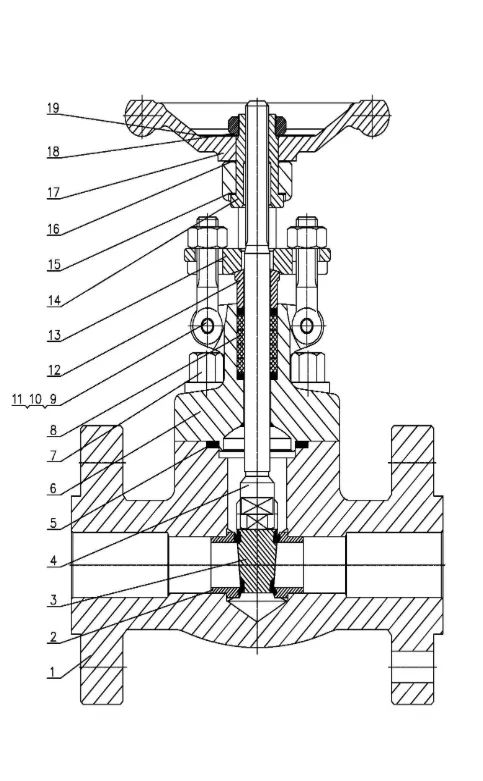 |
| 1 | BODY | ASTM A105 | |
| 2 | SEAT | ASTM A182 F6A | |
| 3 | DISC | ASTM A182 F6A | |
| 4 | STEM | ASTM A182 F6A | |
| 5 | GASKET | SS304 GRAPHITE | |
| 6 | BONNET | ASTM A105 | |
| 7 | HEXBOLT | ASTM A193 B7 | |
| 8 | PACKING | GRAPHITE | |
| 9 | EYEBOLT | ASTM A193 B7 | |
| 10 | PIN | S.S. | |
| 11 | NUT | ASTM A194 2H | |
| 12 | PACKING GLAND | ASTM A182 F6A | |
| 13 | GLAND FLANGE | ASTM A105 | |
| 14 | STEM NUT | ASTM A182 F6A | |
| 15 | WASHER | ASTM A276 410 | |
| 16 | WASHER | ASTM A276 410 | |
| 17 | HANDWHEEL | A197 | |
| 18 | LOCKNUT | C.S. | |
| 19 | NAME PLATE | SS304 |
1. Before installation, check the valve name plate and valve body information to ensure the valve is suitable for the intended service.
2. Before installation, remove the flange cover and the protective film on the flange sealing face, inspect the bore and the flange sealing surface, remove any dirt with a clean soft cloth, use an anti-corrosive cleaning liquid to clean if necessary, and never use any other chemical products.
3. Inspect the flange gasket (including ring gasket) sealing surface and ensure it is in acceptable condition for installation.
4. After cleaning the valve and before installation, open and close the valve one time. Ensure the valve operates smoothly. If abnormal operation is experienced, stop the operation and inspect the valve stem and valve bore for any obstructions that may be preventing normal operation.
5. After successfully cycling and assuring the proper operation of the valve, return the valve to the closed position until installation is complete. If for any reason the valve must remain in the open position, ensure the valve sealing surfaces are protected.
1. Position the valve into the pipe or the flange connection; ensure that any stress caused by improper pipe alignment is relieved first. Valves are not intended to be a means of aligning improperly fitted pipe.
2. Install the valve using qualified piping standards and practices. Valves marked with flow direction must be installed in line with the piping flow.
3. The recommended orientation for slab conduit gate valves is upright with the valve in a horizontal line with the hand wheel positioned vertically above the valve centerline.
| SYMPTOM | PROBABLE CAUSE | SOLUTION |
|
Packing Chamber Leakage |
Eye bolts are loose |
Evenly tighten the eyebolts |
|
Not enough packing / Gland bushing binding |
Increase packing ring quantity |
|
|
Packing worn / Packing chamber damaged |
Replace with new packing |
|
|
Stem sealing surface damaged |
Replace or repair the stem |
|
|
Leakage at sealing surface |
Dirt on the sealing surface |
Clean the sealing surface |
|
Sealing surface damaged |
Adjust eye bolt torque |
|
|
Cannot operate normally |
Packing compressed too tight |
Adjust eye bolt torque |
|
Stem threads and stem nut threads worn out |
Replace stem nut |
|
|
Dirt may be trapped between stem/stem nut, or gland flange/gland |
Remove dirt |
|
|
Bonnet gasket leakage |
Loosen flange bolt/nut |
Re-torque the flange bolt/nut |
|
Bonnet gasket failed |
Replace new gasket |


