
 España
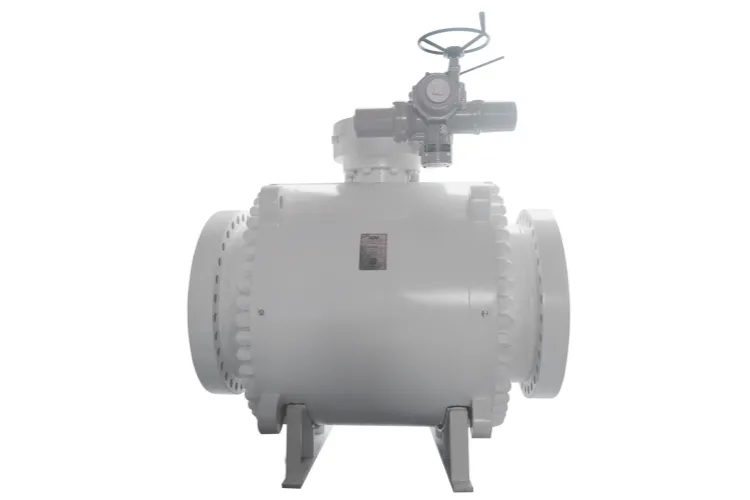
Casting Trunnion Mounted Ball Valve
Cast Steel Trunnion Ball Valves Manufactured by XDV are available in types of Two Piece Split Body & Three Piece Bolted Body Designed and manufactured to the most updated international standards APl 6D, ASME B16.34, BS 5351 or equivalents. With standard features of Fire Safe, Anti-static and Stem Blow-out Proof.
| Size | 2"~48" |
| Rating | 150LB~600LB |
| Body Materials | Carbon Steel, Stainless Steel, XDSS, etc. |
| Design Standards | API 6D/ASME B16.34 |
| Trim | A105 ENP, 13Cr, F304, F316,ECT. |
| Face to Face Standards | ASME B16.10 |
| Flange Dimension Standards | ASME B 16.5/ASME B16.47 |
| Pressure Test Standards | API598,API 6D |
| Quality/Product Certifications | ISO9001, ISO14001, ISO18001 |
| Fugitive Emissions | ISO 15848-1, API 622 |
| NACE | NACE MR 0103 NACE MR 0175 |
| Shutoff Class | API 598 (Zero Leakage), API 6D |
| End Connection | RF, RTJ, BW |
| Operation | Lever, Gear, Motor, Pneumatic |
| NO. | PAPT NAME | MATERIAL-ASTM | 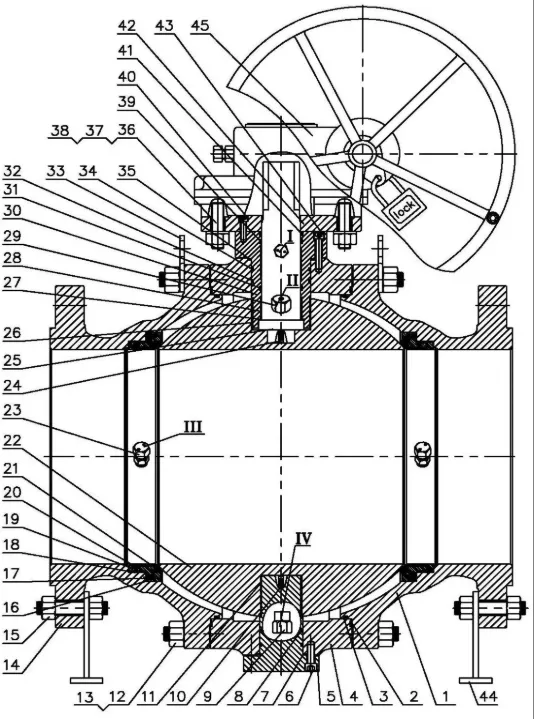 |
NO. | PAPT NAME | MATERIAL-ASTM |
| 1 | BONNET | ASTM A216 WCB | 23 | INJECTION VALVE | C.S. ZN | |
| 2 | GASKET | SS304 GRAPHITE | 24 | ANTI-STATIC | SS304 | |
| 3 | "O"RING | VITON | 25 | STEM | A182 F304 | |
| 4 | BODY | ASTM A216 WCB | 26 | BEARING | SS PTFE | |
| 5 | TRUNNION | ASTM A105 ENP | 27 | THRUST WASHER | RPTFE | |
| 6 | BOLT | A193 B7 | 28 | BEARING | SS PTFE | |
| 7 | GASKET | SS304 GRAPHITE | 29 | VENT | C.S. ZN | |
| 8 | "O"RING | VITON | 30 | STUFFING BOX | ASTM A105 | |
| 9 | DRAIN | C.S. ZN | 31 | "O"RING | VITON | |
| 10 | ANTI-STATIC | SS304 | 32 | "O"RING | VITON | |
| 11 | BEARING | SS PTFE | 33 | LIFT EYE | C.S. | |
| 12 | BOLTS | A193 B7 | 34 | "O"RING | VITON | |
| 13 | NUT | A194 2H | 35 | GASKET | SS304 GRAPHITE | |
| 14 | BONNET | ASTM A216 WCB | 36 | BOLT | A193 B7 | |
| 15 | BOLT | A193 B7 | 37 | NUT | A194 2H | |
| 16 | SEAT RETAINER | A182 F304 | 38 | WASHER | SS | |
| 17 | SPRING | 17-7PH | 39 | "O"RING | VITON | |
| 18 | "O"RING | VITON | 40 | BOLTS | A193 B7 | |
| 19 | "O"RING | VITON | 41 | PACKING | FLEXIBLE GRAPHITE | |
| 20 | PACKING | GRAPHITE | 42 | TOP FLANGE | ATM A105 | |
| 21 | SEAT | RPTFE | 43 | BOLTS | A193 B7 | |
| 22 | BALL | A182 F304 | 44 | SUPPORT | C.S. | |
| 45 | WORM GEAR BOX | CAST IRON |
The installation procedure for ball valves is critical to ensuring both long life and satisfying performance. Valves stored on site awaiting installation should be kept in their original packing, in dry conditions, where damage cannot occur.
Before carrying out the installation, it is important to follow the basic procedures described below:
Carefully unpack the valve and check valve nameplate for identification of materials.
Remove all packing materials.
All valves are bi-directional and supplied ready to use. Valves can be placed with stem oriented to any direction.
Check the valve for any flow direction indication marks. Appropriate care must be taken, to install the valve for proper flow orientation.
Inspect the valve interior through the end ports to determine it is clean and free from foreign matter according to ASME G93-03E1.
Ensure that all auxiliary connections, if any, (lubricators, drains, vents) are free of damage and properly tightened.
Cycle the valve and inspect any functionally significant features.
Read all the literature and note any special warning tags or plates attached to the valve.
Before installation check to insure the ball is in the fully open position in order to prevent possible damage to the ball and seats. The valve performance depends on its original conditions. At any stage do not leave the valve in the partially open position.
Welding of valves shall be performed by a qualified person according to the ASME Boiler Construction Code Section IX. For valves to be welded within the E.U., refer to the requirements of ESR 3.1.2 of the Pressure Equipment Directive 97/23/EC.
Valves that will be welded directly to the line must be in the fully open position to protect the ball and seats from excessive temperatures during the welding procedures.
Protect or remove actuators from weld splatter or arc strikes. Valves in the “Fail Close” position should be cycled to the open position.
Allow free flow of water through the drain bottom valve and overflow through the vent valve to prevent overheating all through the welding process. DO NOT heat the center section over 150° C.
Align valve to pipe line, ensuring proper fit to minimize pipe load. Tack weld only.
Complete welding in small segments. Allow enough time for cooling between each segment.
Do not rotate the valve before flushing the line.
Valves with flanged ends should be treated as a single unit and should not be dismantled when installing to pipeline.
Before installing the valves, make sure that the flanges on the mating pipe are free from excessive grit, dirt or burrs, and that there is no mechanical damage to the flanges on the pipe.
When inserting the flange bolts, make sure the bolts are correct size to hold pressure and axial forces.
|
MALFUNCTION |
PROBABLE CAUSE | SOLUTION |
|
Leakage through the valve |
Ball surface damage |
Replace the ball |
|
Seat damage |
Replace the seats or try with injection of sealant grease |
|
|
Not complete closure |
Check Open/Close limits and settings |
|
|
Ball movement not regular (actuated valves) |
Dirt between ball and seats |
Flush the inside, operating the valve 5 times |
|
Dirt between ball and body cavities |
Flush the inside, operating the valve 5 times |
|
|
Not sufficient air supply flow |
Confirm working conditions are as per request |
|
|
Not sufficient air discharge |
Include quick exhaust valve |
|
|
Valve torque too high |
Seat damage |
Replace the seats |
|
Dirt between ball and seats |
Flush the inside operating the valve 5 times |
|
|
Dirt between ball and body activities |
Flush the inside operating the valve 5 times |
|
|
Excessive Pressure or Temperature |
Confirm working conditions are as per request |
|
|
Stem leakage |
Stem nuts loose |
Tighten stem nuts |
|
Damaged stem seal surfaces |
Replace stem |
|
|
Damaged stem seals |
Replace stem seal or try with injection of sealant grease |
|
|
Body seal leakage |
Gasket damage |
Replace gaskets |
|
Excessive Pressure or Temperature Excessive load from piping system |
Confirm working conditions are as per request Verify piping system architecture |
|
|
Excessive valve noise |
Error in valve sizing |
Confirm valve sizing |
|
Not complete opening |
Check Open/Close limits and settings |
|
|
Fail in valve movement after electrical input (actuated valves) |
Solenoid valve fail |
Confirm power supply Replace the solenoid |
|
Fail in limit switch signal |
Un-correct settings |
Check Open/Close settings |
|
Limit switch is broken |
Replace limit switch |
|
|
Un-correct power supply |
Confirm working conditions are as per request |


