
 España
Types and Functions of Valve Packing: A Comprehensive Guide for Procurement Buyers and Technical Teams
Introduction
Valve packing is one of the most critical yet overlooked components in industrial valve design. Located at the junction between the valve stem and the bonnet, the packing system serves as the primary dynamic seal that prevents media leakage while allowing smooth stem operation. Whether you are a procurement manager sourcing valves for a chemical plant or a mechanical engineer specifying components for a cryogenic installation, understanding the types and functions of valve packing is essential for operational safety, regulatory compliance, and total cost of ownership.
This guide covers every major category of valve packing material, explains their functional roles, compares performance characteristics, and provides practical selection criteria tailored to both buying and engineering perspectives.
What Is Valve Packing and Why Does It Matter?
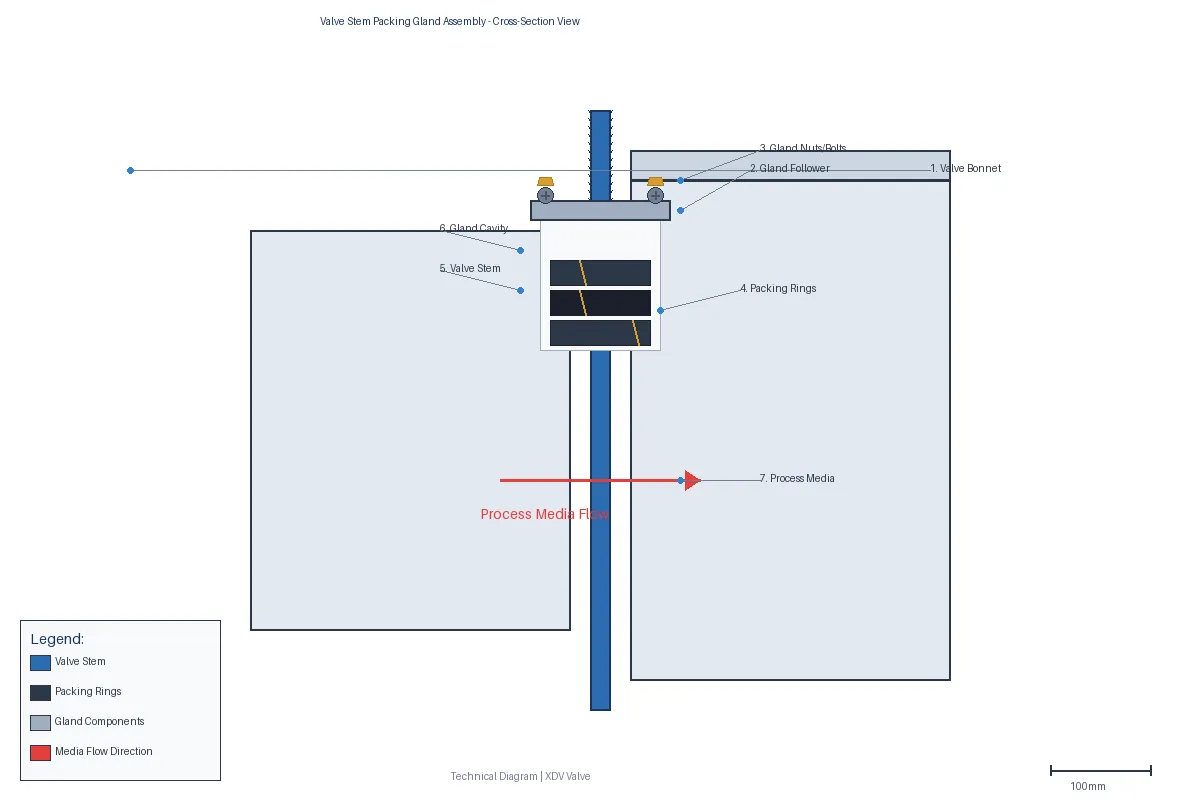
Valve packing consists of compressible sealing elements installed in a gland cavity around the rotating or reciprocating valve stem. Its primary function is to create a controlled dynamic seal that stops process fluid from escaping to the atmosphere while permitting the stem to move freely during valve actuation.
Core Functions of Valve Packing
-
Leakage Prevention -- Seals the stem passage to prevent external release of hazardous, toxic, flammable, or environmentally harmful media.
-
Friction Control -- Provides a lubricated bearing surface that minimizes stem operating torque and wear.
-
Environmental Compliance -- Meets standards such as ISO 15848, EPA Method 21, and TA-Luft for fugitive emission limits.
-
Pressure Containment -- Withstands internal line pressure to prevent blowout of the stem seal area.
-
Corrosion and Chemical Resistance -- Protects the stem from aggressive process fluids and ambient conditions.
For procurement teams, valve packing directly impacts lifecycle costs through replacement frequency, maintenance downtime, and compliance risk. For technical teams, packing selection determines whether a valve will perform reliably under design conditions or suffer premature failure.
Common Types of Valve Packing Materials
1. Graphite Packing
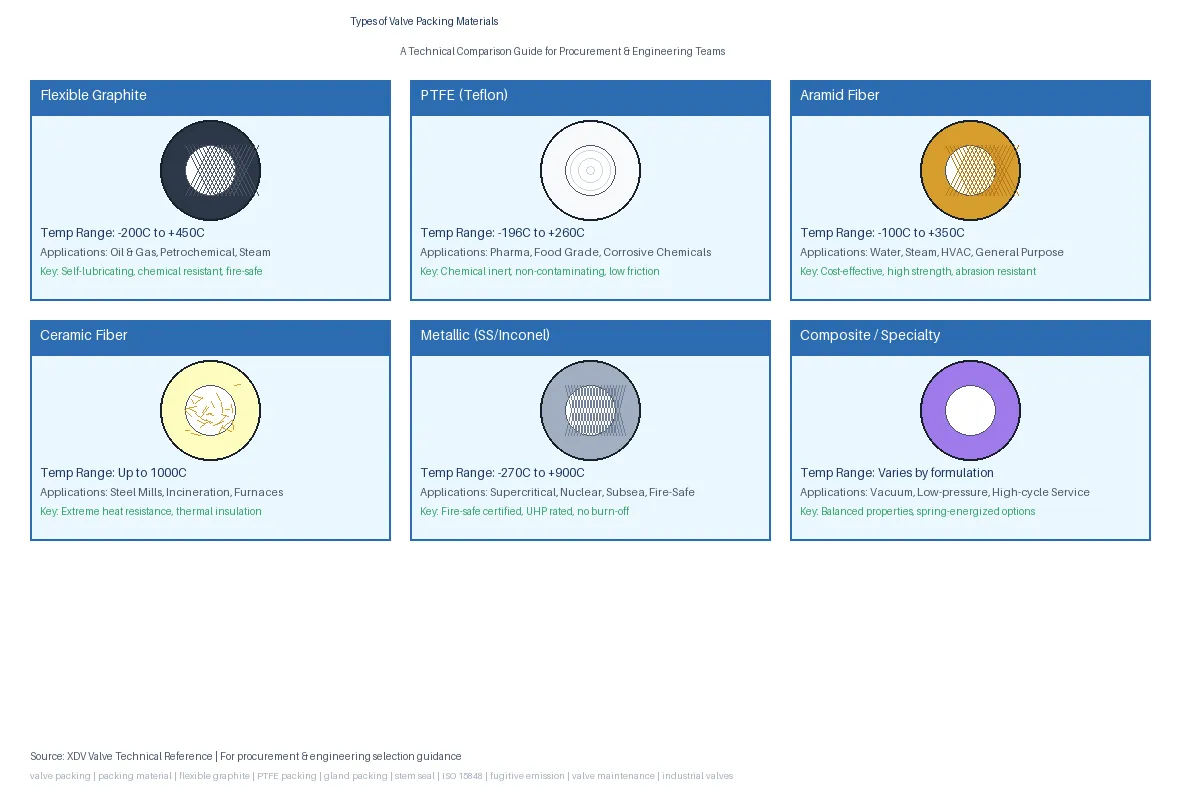
Graphite packing is the most widely used flexible graphite braided or ring-type seal in modern valve applications. It is manufactured from expanded graphite flakes, often combined with stainless steel or nickel foil for reinforcement.
Key Characteristics:
-
Temperature range: -200 degrees C to 450 degrees C (oxidizing media); up to 650 degrees C in inert atmospheres
-
Excellent chemical resistance to almost all process media except strong oxidizers
-
Self-lubricating with low friction coefficient
-
Excellent thermal conductivity and creep resistance
-
Complies with ISO 15848 fugitive emission standards
Best Applications:
-
Oil and gas upstream/downstream facilities
-
Petrochemical refining units
-
High-temperature steam services
-
Sour gas environments (H2S-containing)
Procurement Perspective: Flexible graphite packing commands a premium price over conventional PTFE options but delivers significantly longer service life in demanding environments. Total cost of ownership often favors graphite despite higher unit cost.
Technical Perspective: Graphite packing requires proper gland adjustment during commissioning. Over-compression can damage the valve stem coating, while under-compression leads to measurable fugitive emissions. Pairing graphite packing with coated stems (e.g., HVOF or PTFE-lined) maximizes performance.
2. PTFE (Polytetrafluoroethylene) Packing
PTFE packing is available in braided, pressed, or V-ring configurations and represents the go-to choice for corrosive chemical service where temperature limits are moderate.
Key Characteristics:
-
Temperature range: -196 degrees C to 260 degrees C (short-term peaks to 300 degrees C)
-
Outstanding chemical inertness -- resistant to virtually all chemicals
-
Very low friction coefficient (approximately 0.04)
-
Non-contaminating and food-grade options available
-
Low compression set in moderate-duty cycles
Best Applications:
-
Pharmaceutical and bioprocessing valves
-
Food and beverage industry
-
Aggressive acid and caustic service
-
Semiconductor manufacturing
-
Water treatment facilities
Procurement Perspective: PTFE packing offers the lowest upfront cost among high-performance packing materials. However, its limited temperature capability and higher compression set mean more frequent repacking in cyclic service compared to graphite alternatives.
Technical Perspective: PTFE exhibits cold flow (creep) under sustained load, necessitating periodic gland re-tightening. For applications requiring zero contamination, virgin PTFE or PTFE-packed rings with FDA certification are mandatory. Consider filled PTFE variants (glass-filled, carbon-filled) for improved wear resistance.
3. Aramid Fiber (Kevlar) Packing
Aramid fiber packing is a high-strength, heat-resistant braided material commonly used as a cost-effective alternative to graphite in moderate-temperature applications.
Key Characteristics:
-
Temperature range: -100 degrees C to 350 degrees C (dry); lower in wet service
-
High tensile strength and excellent abrasion resistance
-
Good chemical resistance to alkalis, solvents, and hydrocarbons
-
Lightweight and easy to install
-
Lower cost than graphite packing
Best Applications:
-
General-purpose water and steam valves
-
HVAC and utility services
-
Low-pressure gas distribution
-
Food-grade non-critical service
Procurement Perspective: Aramid fiber packing provides the best price-to-performance ratio for non-hazardous, moderate-temperature services. It is an excellent standard packing for commodity valves where fugitive emission compliance is not the primary driver.
Technical Perspective: Aramid fiber packing performs well in dry steam but degrades rapidly in wet, high-velocity flow conditions. It is not recommended for sour gas or highly corrosive chemical service. Lubrication during installation is essential to achieve proper seating.
4. Ceramic Fiber Packing
Ceramic fiber packing is designed for extreme-temperature applications where both graphite and aramid fiber fall short.
Key Characteristics:
-
Temperature range: up to 1000 degrees C (short-term up to 1260 degrees C)
-
Excellent thermal insulation properties
-
Chemically inert to most molten metals and slags
-
Low thermal conductivity
-
Brittle and fragile handling characteristics
Best Applications:
-
Steel mill and foundry valves
-
Incineration and waste-to-energy plants
-
High-temperature furnace isolation valves
-
Glass manufacturing processes
Procurement Perspective: Ceramic fiber packing is a niche, high-cost item. Procurement teams should verify actual temperature requirements before specifying, as graphite may suffice for many applications previously thought to require ceramic.
Technical Perspective: Due to its brittle nature, ceramic fiber packing requires careful handling and installation. It is typically used in stationary high-temperature seals rather than dynamic stem packing. For moving stems at extreme temperatures, consider metal-jacketed or bellows-sealed valve designs instead.
5. Metallic Packing (Stainless Steel, Inconel, Monel)
Metallic packing uses braided or corrugated metal strips, typically stainless steel 304/316, Inconel 625, or Monel 400, to provide sealing in the most extreme service conditions.
Key Characteristics:
-
Temperature range: -270 degrees C to 900 degrees C (material-dependent)
-
Exceptional pressure rating (up to and beyond Class 4500)
-
Resistant to radiation, abrasion, and fire
-
No organic decomposition or burn-off
-
Requires precise machining and installation
Best Applications:
-
Supercritical power plants
-
Deepwell and subsea valves
-
Nuclear service valves
-
Fire-safe certified valve assemblies (API 607/6FA)
-
Ultra-high-pressure (UHP) hydraulic systems
Procurement Perspective: Metallic packing significantly increases valve cost but is non-negotiable for fire-safe certification and ultra-high-pressure service. Ensure that the valve manufacturer has demonstrated metallic packing performance in third-party fire-safe tests.
Technical Perspective: Metallic packing relies on elastic deformation of the metal elements to maintain seal integrity. Proper initial preload and consideration of thermal cycling effects are critical. In cryogenic service, differential thermal contraction between the packing and stem must be accounted for in the gland design.
6. Composite and Specialty Packing
Modern valve packing increasingly incorporates composite materials that combine the advantages of multiple base materials.
Common Variants:
|
Type |
Composition |
Key Advantage |
|---|---|---|
|
Graphite-PTFE composite |
Expanded graphite PTFE binders |
Balanced temp/chemical range |
|
PTFE-covered graphite |
Graphite core with PTFE face |
Zero-emission, chemical resistance |
|
Spring-energized PTFE |
Metal spring PTFE lip seal |
Consistent seal under pressure cycling |
|
Carbon fiber reinforced |
Carbon fiber PTFE/graphite matrix |
High strength, low friction |
Procurement Perspective: Composite packings offer the best of both worlds but come at a premium. Evaluate whether a hybrid approach -- different packing grades at different stem positions -- can optimize performance and cost.
Technical Perspective: Spring-energized PTFE seals are particularly effective in vacuum and low-pressure applications where conventional compressed packing cannot maintain adequate contact stress. Carbon fiber reinforced packing excels in high-speed actuator service where friction-induced heating is a concern.
Valve Packing Configurations and Gland Designs
Beyond material selection, the physical configuration of packing elements within the gland cavity is equally important.
Standard Packing Ring Arrangements
Braided Packing Rings:
-
Multiple turns of braided cord cut into rings
-
Stacked in the gland cavity and compressed by the gland follower
-
Most common configuration for general-purpose valves
-
Require periodic re-tightening as the braid settles
Pressed/Rigid Rings:
-
Pre-formed rings machined from solid PTFE or composite stock
-
Provide consistent cross-sectional dimensions
-
Lower friction than braided types
-
Cannot self-adjust as easily as braided packing
V-Ring and U-Ring Seals:
-
Lip seals oriented to direct pressure against the lip face
-
Typically installed in opposing pairs for double-seal effect
-
Common in high-pressure and high-cycle applications
-
Require precise gland depth control during assembly
Labyrinth and Non-Contact Designs:
-
Use tortuous flow paths rather than direct contact sealing
-
Eliminate friction entirely, enabling unlimited cycle life
-
Used primarily in clean gas and vacuum service
-
Larger gland diameter required compared to contact seals
Double Packing and Barrier Systems
For critical applications where a single packing set is insufficient, manufacturers employ double packing arrangements:
-
Dual Sealing Rings -- Two independent packing sets with a barrier groove between them
-
Barrier Fluid Injection -- Clean inert fluid injected into the inter-seal cavity to prevent process media migration
-
Mechanical Face Seals -- Replaces traditional packed glands with cartridge-style mechanical seals for zero-emission performance
Procurement Perspective: Double packing increases both initial cost and maintenance complexity. Justify this investment based on the consequences of leakage: environmental fines, safety incidents, or production losses far outweigh the incremental packing cost.
Technical Perspective: Barrier fluid systems require auxiliary piping, pressure regulation, and leak detection instrumentation. Ensure that the valve vendor provides complete system specifications including barrier fluid compatibility, flow rates, and alarm setpoints.
How to Select the Right Valve Packing: Decision Framework
Step 1: Identify Process Conditions
|
Parameter |
Questions to Ask |
|---|---|
|
Temperature |
Maximum, minimum, and fluctuating range? |
|
Pressure |
Operating and maximum allowable pressure? |
|
Media Type |
Corrosive, abrasive, toxic, flammable, food-grade? |
|
Cycle Frequency |
How many open/close cycles per day? |
|
Emission Requirements |
ISO 15848, TA-Luft, or EPA compliance needed? |
Step 2: Match Material to Application
|
Service Condition |
Recommended Packing |
|---|---|
|
General water/steam |
Aramid fiber or graphite |
|
Corrosive chemicals |
PTFE (virgin or filled) |
|
High temperature (over 350 degrees C) |
Flexible graphite |
|
Cryogenic (under -100 degrees C) |
Graphite or PTFE (material-specific) |
|
Fire-safe certification |
Metallic or graphite with fire-resistant elements |
|
Ultra-high pressure |
Metallic packing or spring-energized PTFE |
|
Food/pharma grade |
Virgin PTFE (FDA-compliant) |
Step 3: Evaluate Total Cost of Ownership
Procurement teams should calculate TCO including:
-
Initial packing material cost
-
Expected replacement interval
-
Labor cost for repacking
-
Downtime cost per maintenance event
-
Compliance and environmental penalty risk
A graphite packing ring that lasts 3 years typically delivers lower TCO than a .50 PTFE ring replaced every 6 months in a high-temperature service.
Maintenance and Troubleshooting
Common Packing Failure Modes
-
Excessive Leakage -- Caused by worn packing, improper gland adjustment, stem scoring, or incorrect material selection
-
High Operating Torque -- Over-compressed gland, degraded packing material, or stem misalignment
-
Packing Blowout -- Excessive system pressure beyond packing rating, missing backup rings, or damaged gland follower
-
Chemical Degradation -- Incompatible packing material with process media
-
UV/Ozone Deterioration -- Organic packing materials exposed to outdoor conditions without protection
Best Practices for Packing Maintenance
-
During Installation: Clean the gland cavity thoroughly, inspect the stem for scoring or corrosion, and install rings with staggered joints (typically 90 degrees or 120 degrees apart)
-
During Commissioning: Apply gradual, incremental gland tightening while cycling the valve through several full strokes
-
During Operation: Monitor for visible leakage and operating torque changes; address minor weeping immediately before it escalates
-
During Scheduled Maintenance: Replace entire packing sets rather than topping off old rings; record gland position for future reference
Regulatory and Standards Overview
Understanding relevant standards is essential for both procurement specification and engineering validation:
-
ISO 15848 (Parts 1 and 2): Factory testing procedure for fugitive emission performance of valves
-
API 624: Standard for testing rotary dynamic seals (alternative to packed glands)
-
API 641: Recommended practice for type testing of valving
-
EN 15848: European equivalent of ISO 15848
-
TA-Luft: German federal emission control regulations for volatile organic compounds
-
EPA Method 21: U.S. protocol for detecting volatile organic compound leaks
-
API 607 / API 6FA: Fire-safe testing for soft-seated and metal-seated valves
-
PED 2014/68/EU: European Pressure Equipment Directive (affects packing selection for pressure equipment)
Conclusion
Valve packing is far more than a simple sealing element -- it is an engineered system that balances competing demands of leak-tight performance, operability, chemical compatibility, temperature endurance, and regulatory compliance. For procurement buyers, selecting the right packing material is a strategic decision that affects lifecycle cost, supply chain resilience, and compliance posture. For technical teams, packing specification is integral to valve reliability, safety, and overall plant performance.
At XDV Valve, we offer comprehensive valve packing solutions across all major material categories -- from standard aramid fiber braids for utility service to certified flexible graphite and metallic packing for the most demanding applications. Our technical team can assist with material selection, gland design optimization, and compliance verification to ensure your valves perform reliably throughout their design life.
Need help selecting the right valve packing for your application? Visit [https://www.xdv-valve.com/contactus/](https://www.xdv-valve.com/contactus/) for personalized recommendations and competitive quotations.
