
 España
The Ultimate Guide to 3-Way Ball Valves: Types, Applications & How to Choose the Right One
Introduction
In industrial fluid control systems, 3-way ball valves are among the most versatile and widely used components across manufacturing, chemical processing, water treatment, HVAC, and food & beverage industries. Whether you are directing flow between multiple pathways, mixing two fluids, or diverting flow to different destinations, a 3-way ball valve provides reliable performance with minimal maintenance.
This comprehensive guide covers everything you need to know about 3-way ball valves — from their working principle and configuration types to material selection, industry applications, and buying considerations. If you are sourcing 3-way ball valves for your next project, this article will help you make an informed decision.
What Is a 3-Way Ball Valve?
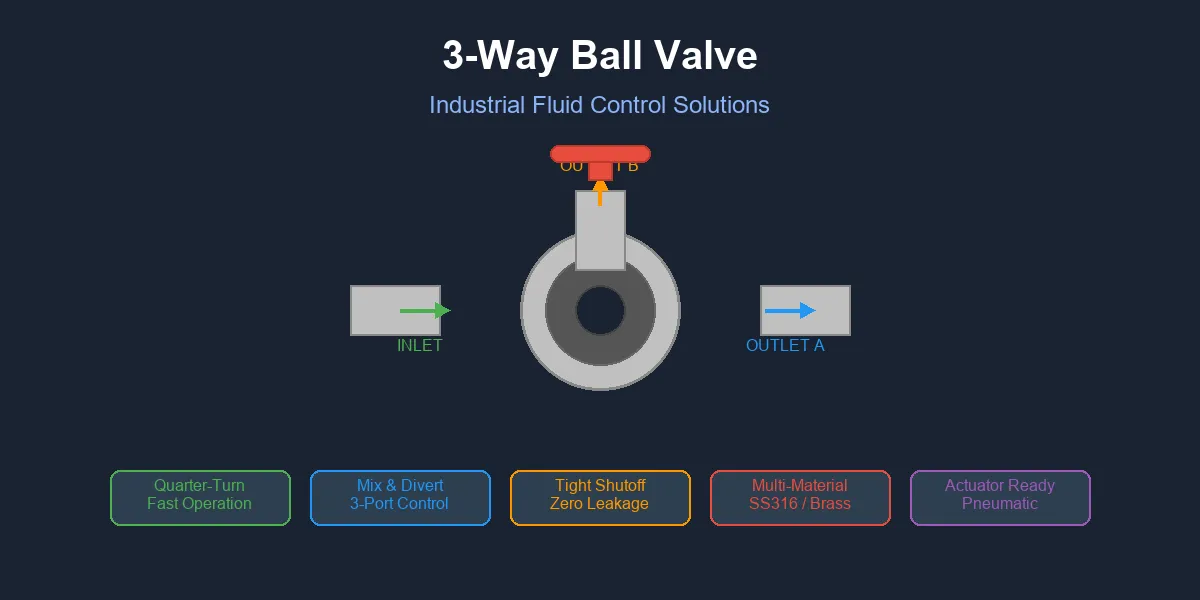
A 3-way ball valve is a type of quarter-turn rotary valve that controls fluid flow through three ports. Unlike a standard 2-way ball valve, which simply opens or closes a single flow path, a 3-way ball valve can mix, divert, or distribute fluid flow between three different connections.
The valve features a hollow, pivoting ball inside a valve body with three ports labeled typically as Port 1 (inlet), Port 2 (outlet), and Port 3 (divert outlet). By rotating the ball 90 degrees, operators can change the flow direction without shutting down the entire system.
Key Components of a 3-Way Ball Valve
-
Valve Body: The main housing, available in materials like stainless steel, carbon steel, brass, PVC, and alloy steels
-
Ball: The rotating closure element with a drilled passage that controls flow direction
-
Stem: Connects the actuator or handle to the ball for operation
-
Seat Seals: Provide tight shutoff and prevent leakage
-
Handle or Actuator: Manual lever, gear operator, pneumatic, or electric actuation
-
Gaskets and Packing: Ensure pressure-tight seals
How Does a 3-Way Ball Valve Work?
The operation of a 3-way ball valve relies on the rotation of a spherical ball with a ported hole. When the port aligns with the inlet, fluid flows through. Rotating the ball 90 degrees changes the flow path, enabling mixing, diverting, or distribution functions.
Flow Configuration Positions
Most 3-way ball valves operate in two primary positions:
-
Position A (L-Port): Flow connects Port 1 to Port 2, while Port 3 is closed
-
Position B (L-Port): Flow connects Port 1 to Port 3, while Port 2 is closed
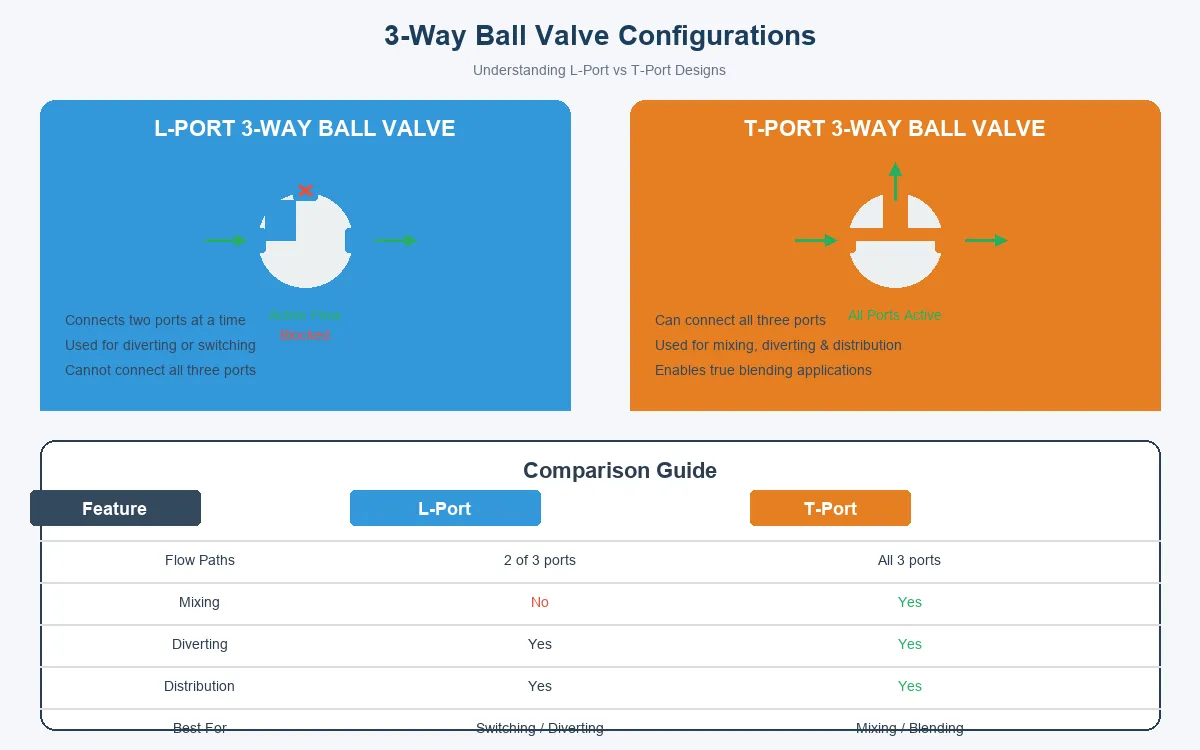
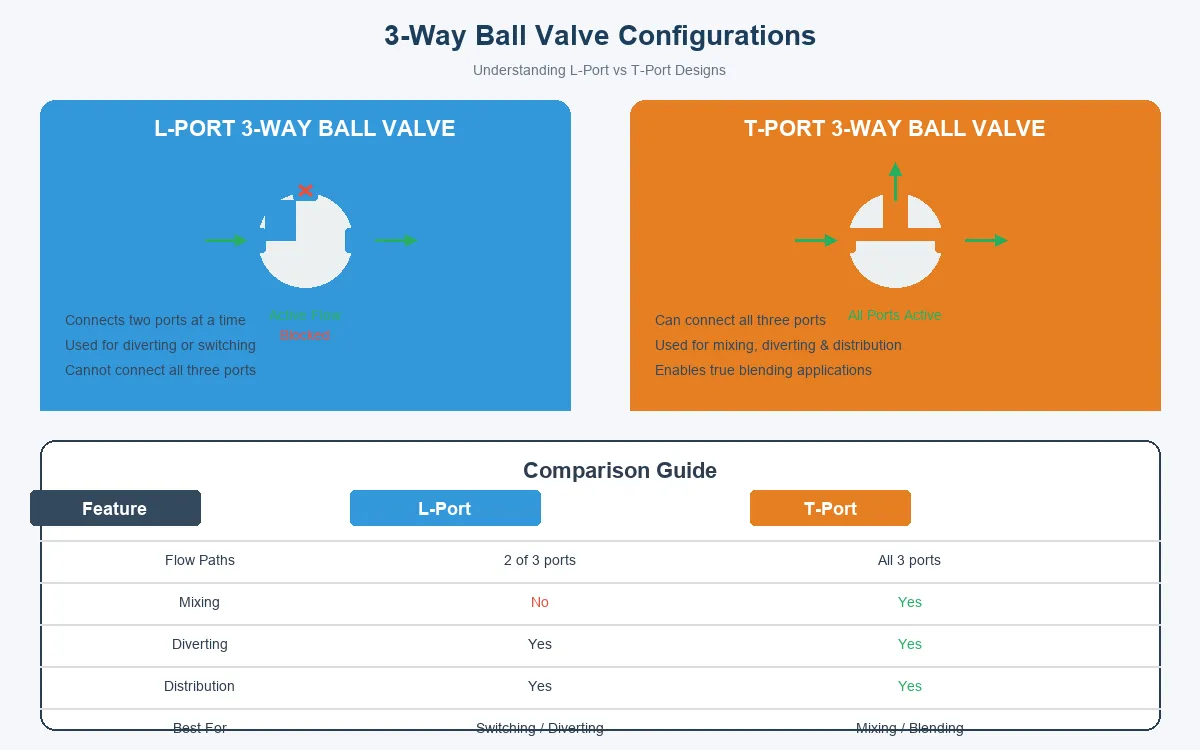
Some configurations offer a T-Port design that allows all three ports to be connected simultaneously, enabling true mixing applications.
Types of 3-Way Ball Valves
Selecting the right type of 3-way ball valve depends on your application requirements, media compatibility, temperature range, and pressure class. Here are the main configurations:
1. L-Port 3-Way Ball Valve
An L-port 3-way ball valve has an L-shaped port in the ball. It is designed for diverting or distributing flow between two paths but cannot connect all three ports simultaneously.
Best for:
-
Diverting flow from one source to two different destinations
-
Switching between two supply lines
-
Simple on/off control in dual-path systems
2. T-Port 3-Way Ball Valve
A T-port 3-way ball valve features a T-shaped passage in the ball, allowing all three ports to be open simultaneously. This enables mixing, diverting, and distribution functions.
Best for:
-
Mixing two fluid streams into one outlet
-
Diverting one inlet to two outlets
-
Bypass applications
-
Continuous flow processes requiring blending
3. Full-Bore 3-Way Ball Valve
A full-bore (full cavity) 3-way ball valve has a ball diameter equal to the pipe inner diameter, minimizing pressure drop and allowing pigging operations.
Best for:
-
High-flow applications
-
Pipeline cleaning requirements
-
Low-pressure-drop environments
4. Reduced-Bore 3-Way Ball Valve
A reduced-bore 3-way ball valve features a smaller ball diameter than the pipe size, resulting in a slightly higher pressure drop but lower cost and weight.
Best for:
-
Cost-sensitive applications
-
Moderate flow requirements
-
Space-constrained installations
5. V-Port 3-Way Ball Valve
A V-port 3-way ball valve has a shaped (V-notch) ball opening that provides precise throttling and flow regulation capabilities.
Best for:
-
Modulating flow control
-
Slurry and viscous fluid applications
-
Process industries requiring fine flow adjustment
3-Way Ball Valve Materials
Material selection is critical for valve performance, longevity, and compliance with industry standards. Here are the most common materials used in 3-way ball valves:
|
Material |
Best Application |
Temperature Range |
Corrosion Resistance |
|---|---|---|---|
|
Stainless Steel (304/316) |
Chemical, food & beverage, pharmaceutical |
-40 to 600 degrees C |
Excellent |
|
Carbon Steel |
Oil & gas, power plants |
-29 to 425 degrees C |
Good |
|
Brass |
Water systems, HVAC, irrigation |
-20 to 200 degrees C |
Very Good |
|
PVC/CPVC |
Chemical processing, wastewater |
-10 to 90 degrees C |
Excellent for chemicals |
|
Duplex Stainless Steel |
Seawater, offshore, acidic environments |
-50 to 300 degrees C |
Superior |
|
Inconel / Hastelloy |
Extreme corrosion, high-temperature |
Up to 1000 degrees C |
Exceptional |
3-Way Ball Valve End Connections
3-way ball valves come with various end connection types to suit different piping systems:
-
Threaded (NPT/BSP): Most common for small to medium sizes (half inch to 4 inches)
-
Flanged (ANSI/ASME/DIN): Used for larger sizes and higher pressure ratings
-
Socket Weld: For high-pressure, high-temperature services
-
Butt Weld: For permanent, leak-free connections in critical service
-
Compression/Ferrule: For instrument tubing and small-bore piping
Common 3-Way Ball Valve Standards
When sourcing 3-way ball valves, ensure compliance with recognized industry standards:
-
API 6D: Specification for pipeline valves
-
API 598: Valve inspection and testing
-
ASME B16.34: Valve flanged, threaded, and welding end connections
-
ISO 17292: Metal valves for petroleum and natural gas industries
-
MSS SP-61: Performance testing for ball valves
-
EN 593: Butterfly, ball, and plug valves
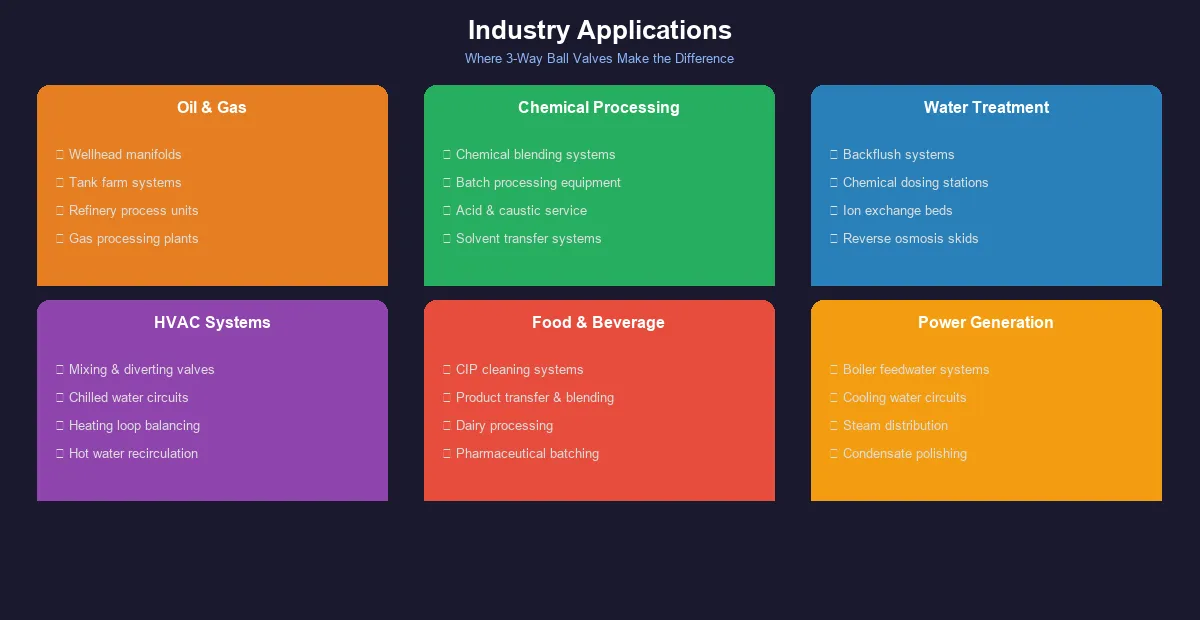
Industry Applications of 3-Way Ball Valves
1. Oil & Gas Industry
3-way ball valves are essential in upstream, midstream, and downstream oil and gas operations. They are used in:
-
Wellhead manifolds and flowlines
-
Tank farms and storage facilities
-
Refinery process units
-
Gas processing plants
2. Chemical & Petrochemical
In chemical processing, 3-way ball valves handle corrosive, toxic, and high-purity media:
-
Chemical blending and mixing systems
-
Batch processing equipment
-
Acid and caustic service
-
Solvent transfer systems
3. Water Treatment & Desalination
Water treatment plants rely on 3-way ball valves for:
-
Backflush systems
-
Chemical dosing stations
-
Mixed-bed ion exchange
-
Reverse osmosis skids
4. HVAC & Building Services
HVAC applications include:
-
Three-way mixing and diverting valves
-
Chilled water systems
-
Heating loop balancing
-
Domestic hot water recirculation
5. Food & Beverage / Pharmaceutical
Hygienic 3-way ball valves (sanitary tri-clamp type) are used in:
-
CIP (Clean-in-Place) systems
-
Product transfer and blending
-
Dairy processing
-
Pharmaceutical batching
6. Power Generation
Power plant applications:
-
Boiler feedwater systems
-
Cooling water circuits
-
Steam distribution
-
Condensate polishing
Advantages of 3-Way Ball Valves
Why choose a 3-way ball valve over other valve types?
-
Compact Design: Replaces multiple 2-way valves, saving space and reducing potential leak points
-
Quarter-Turn Operation: Fast and easy to operate manually or with actuators
-
Tight Shutoff: Bi-directional sealing with low leakage rates
-
Low Torque: Smooth operation even in high-pressure applications
-
Versatile Flow Control: Mixing, diverting, and distribution in a single valve
-
Durability: Long service life with minimal maintenance
-
Fire-Safe Design: Many models meet API 607 fire-safe standards
-
Automation Ready: Compatible with pneumatic, electric, and hydraulic actuators
3-Way Ball Valve vs. Other Valve Types
|
Feature |
3-Way Ball Valve |
3-Way Globe Valve |
3-Way Plug Valve |
3-Way Butterfly Valve |
|---|---|---|---|---|
|
Flow Control |
Good |
Excellent |
Fair |
Fair |
|
Pressure Drop |
Low |
Moderate |
Low |
Low-Moderate |
|
Cost |
Moderate |
Higher |
Moderate |
Lower |
|
Size |
Compact |
Larger |
Compact |
Large |
|
Maintenance |
Low |
Moderate |
Low |
Low |
|
Shutoff |
Tight |
Tight |
Good |
Moderate |
How to Choose the Right 3-Way Ball Valve
Selecting the correct 3-way ball valve requires evaluating several factors:
1. Identify Your Flow Requirement
-
Mixing? Choose a T-port configuration
-
Diverting? An L-port configuration is sufficient
-
Distribution? Both L-port and T-port may work depending on your needs
2. Check Media Compatibility
Ensure the valve material is compatible with the fluid being handled. Consider:
-
Chemical composition
-
pH level
-
Presence of solids or slurries
-
Temperature and pressure conditions
3. Size and Pressure Rating
Select the appropriate nominal pipe size (NPS) and pressure class (Class 150, 300, 600, 900, 1500, 2500) based on your system requirements.
4. Connection Type
Match the end connection to your piping system — threaded, flanged, welded, or sanitary.
5. Actuation vs. Manual
For remote operation or frequent cycling, consider pneumatic or electric actuated 3-way ball valves. For infrequent operation, a manual lever or gear operator is sufficient.
6. Certification Requirements
Depending on your industry, you may need:
-
FDA-compliant materials for food & beverage
-
USP Class VI for pharmaceutical
-
ATEX/IECEx for explosive atmospheres
-
NACE MR0175 for sour service
Sourcing 3-Way Ball Valves
When purchasing 3-way ball valves, consider working with experienced manufacturers and suppliers who can provide:
-
Custom configurations and sizing
-
Material certifications and traceability
-
Pressure testing and inspection reports
-
Actuator integration and automation packages
-
Technical support and engineering consultation
[Contact us] for premium 3-way ball valves engineered for reliability, performance, and competitive pricing. Our team can help you select the ideal valve configuration for your specific application requirements.
Frequently Asked Questions (FAQ)
What is the difference between L-port and T-port 3-way ball valves?
An L-port 3-way ball valve connects two ports at a time and is used for diverting or switching flow between two paths. A T-port 3-way ball valve can connect all three ports simultaneously, enabling mixing or combining of fluid streams.
Can a 3-way ball valve be used for mixing?
Yes, a T-port 3-way ball valve is specifically designed for mixing applications where two inlet streams need to be combined into a single outlet.
What sizes are 3-way ball valves available in?
3-way ball valves are commonly available from half inch to 12 inches (DN15 to DN300), with larger sizes available upon request.
Are 3-way ball valves bidirectional?
Most 3-way ball valves offer bidirectional sealing, meaning they can seal flow from either direction. However, this depends on the specific design and seat configuration.
What is the typical lead time for 3-way ball valves?
Standard sizes and configurations typically ship within 2-4 weeks. Custom specifications, special materials, or actuated valves may require 6-12 weeks.
Can 3-way ball valves handle high-pressure applications?
Yes, 3-way ball valves are available in pressure ratings from Class 150 to Class 2500, suitable for high-pressure services up to several thousand PSI.
Conclusion
3-way ball valves are indispensable components in modern fluid control systems, offering unmatched versatility in mixing, diverting, and distribution applications. With a wide range of materials, configurations, and actuation options available, there is a 3-way ball valve solution for virtually every industrial requirement.
By understanding the differences between L-port and T-port designs, selecting the right materials for your media, and partnering with an experienced supplier, you can ensure optimal performance and reliability in your systems.
For high-quality 3-way ball valves backed by expert engineering support, [visit our website] or [contact our team] today. We offer competitive pricing, fast delivery, and comprehensive technical assistance for all your valve needs.
